
Why Two Retirees Can Earn The Same Return... And One Still Runs Out Of Money
The hidden danger of sequence-of-returns risk.

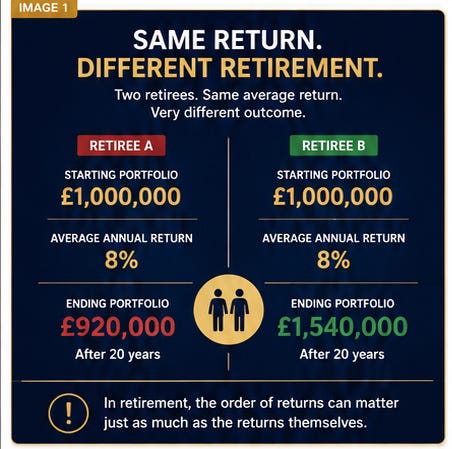
Same Return. Different Retirement.
Two portfolios.
Both start with £1,000,000
Both earn 8% average annual returns
One ends retirement with substantially more wealth.
The other begins to lose his money.
In retirement, the order of returns can matter just as much as the returns themselves.
Introduction
Ask someone what determines a successful retirement and they’ll usually give the same answer:
“You need good investment returns.”
That certainly helps.
But surprisingly, it isn’t the whole story.
For retirees, the order in which those returns occur can be just as important as the returns themselves.
This is known as sequence-of-returns risk, and it is one of the most misunderstood risks in investing.
In fact, two retirees can experience exactly the same average annual return over twenty years...
...yet one enjoys a comfortable retirement while the other watches their portfolio slowly disappear.
Let’s see why.
Meet Two Retirees
Imagine two investors.
Both retire today with a portfolio worth £1,000,000.
Both withdraw £40,000 per year, increasing that amount with inflation.
Over the next twenty years, both achieve exactly the same average investment return.
On paper, they’ve had identical investments.
Yet one finishes retirement with substantially more money than the other.
How can that be?
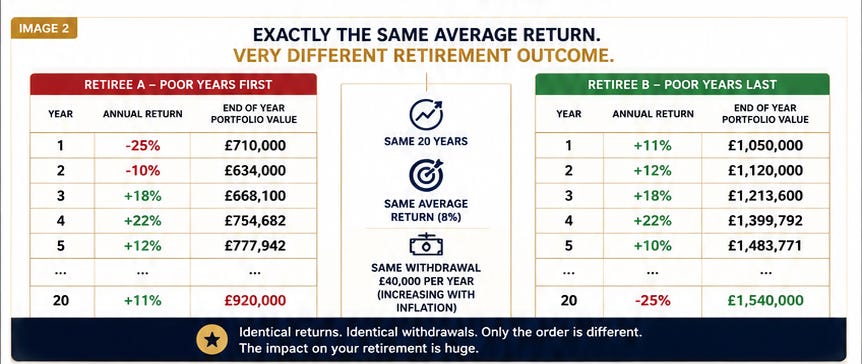
Exactly the same average return.
Very different retirement outcome.
Why Does This Matter?
When you’re still working, market crashes are unpleasant...
...but they aren’t necessarily disastrous.
You’re still earning a salary.
You’re still buying investments.
Lower prices may actually benefit you.
Retirement changes everything.
Now your portfolio is funding your lifestyle.
Instead of buying investments after market falls...
...you’re selling them.
That means fewer shares remain invested when markets eventually recover.
This creates a permanent drag on future wealth.
Year after year.
The Snowball Effect
Imagine withdrawing £40,000 from a portfolio that’s just fallen 30%.
You’re forced to sell significantly more investments than you would have done only a year earlier.
Those investments can never participate in the recovery.
That damage compounds.
This is why retirees often fear bear markets much more than younger investors.
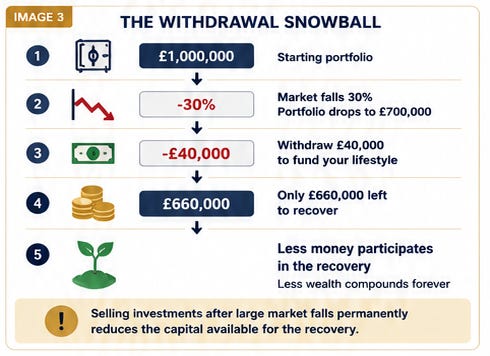
Selling investments after large market falls permanently reduces the capital available for the recovery.
Sequence Risk Isn’t About Average Returns
This is perhaps the most surprising part.
If you looked only at the average return...
Both retirees appear identical.
Average return tells you nothing about when gains and losses occurred.
Retirement investing is one of the few situations where timing genuinely matters.
Not market timing.
Return sequencing.
That’s a completely different concept.
What Can Investors Do?
Unfortunately, sequence risk can never be eliminated completely.
Markets will always fluctuate.
Bear markets will always happen.
But investors can reduce its impact.
Examples include:
Maintaining cash reserves.
Flexible withdrawal strategies.
Holding diversified portfolios.
Avoiding unnecessary panic selling.
Managing portfolio drawdowns.
Each approach attempts to solve the same underlying problem:
Avoid selling large amounts of investments immediately after severe market declines.
Why Drawdowns Matter So Much
This is one reason why I place so much emphasis on drawdowns.
Many investors judge a strategy almost entirely by its annualised return.
I don’t.
I care just as much about how painful the journey is. Hence my obsession with things like the Calmar ratio.
A portfolio that loses 12% feels very different from one that loses 30%.
Not just emotionally...
Financially as well.
Smaller drawdowns mean less capital has been destroyed.
Less capital needs recovering.
Less pressure from withdrawals.
Greater confidence to stay invested.
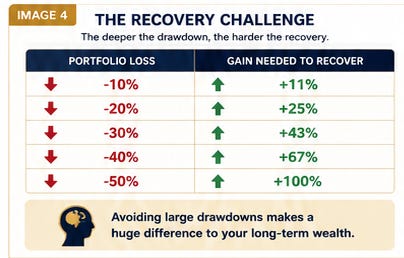
The deeper the drawdown, the harder the recovery.
This Is Why I Built The Retirement Portfolio
When I retired, I realised my priorities had changed.
I no longer needed the most aggressive portfolio possible.
I needed one that could continue growing while reducing the impact of major market declines.
That doesn’t mean avoiding equities altogether.
Nor does it mean trying to predict the future.
Instead, The Retirement Portfolio uses a systematic process that seeks to participate in rising markets while adapting when market conditions deteriorate.
No investment strategy removes risk.
No investment strategy avoids every loss.
But reducing the depth of major drawdowns may improve both the financial and psychological experience of investing through retirement.
Final Thoughts
Most investment discussions begin with one question:
“What’s the expected return?”
For retirees, a better question may be:
“What happens if the first few years are terrible?”
That’s the question sequence-of-returns risk asks.
And it’s one of the main reasons The Retirement Portfolio focuses not only on growing wealth...
...but on helping investors preserve it when it matters most.
Subscribe
If you’re interested in retirement investing, drawdown management and systematic ETF investing, consider subscribing below.
Free subscribers receive educational articles like this.
Paid subscribers also receive the live monthly portfolio allocation, strategy updates and ongoing research.
Having read this, you mention having cash reserves to protect against a bear market. All of your funds are in ETFs. Are the way the ETFs are structured meant to remove the need for short term cash bucket? Thanks