
The Retirement Portfolio: ETF Strategy. Equal the market with half the drawdown.
A Drawdown-First ETF Strategy for Retirement Investors

Why I Built The Retirement Portfolio
After retiring in my early forties, my priorities changed. I no longer needed to maximise returns at all costs. I needed a portfolio that could continue growing while limiting the deep drawdowns that make retirement investing so difficult.
Traditional passive investing works well for many people, but retirement introduces a different challenge. Large losses early in retirement can permanently damage a portfolio through sequence risk.
I couldn’t find an ETF strategy that prioritised drawdown control without sacrificing long-term growth, so I built one myself.
What Makes It Different?
🛡️ Drawdown-first: Protects capital.
📈 Growth-focused: Participates and captures rising markets.
🔄 Always invested: Holds an adjusting basket of growth and defensive ETFs instead of trying to predict the future.
How The Strategy Works
The strategy combines a small number of low-cost ETFs representing global growth assets and defensive assets.
Each month it evaluates the strength of market trends using objective rules. When markets are healthy, it favours growth ETFs. When conditions deteriorate, it gradually rotates towards defensive assets such as government bonds, gold, commodities or cash equivalents.
There are no forecasts, opinions or discretionary decisions. Every monthly allocation follows exactly the same systematic process.
The ETF universe is deliberately conservative. It consists of large, highly liquid, low-cost ETFs with long trading histories. I deliberately avoid fashionable niche ETFs or newly launched products that lack sufficient evidence across multiple market cycles. I will often only start to look at an ETF once it has 10 years history.
Although the strategy is intentionally simple to follow, a great deal of research sits behind the scenes. The monthly signal is the end result of years of testing, refinement and validation, covering areas such as asset selection, momentum measurement, defensive asset rotation, portfolio construction, execution timing, robustness testing and risk management.
Paid subscribers see the final allocation each month. The complexity is in designing a process that remains robust across different market environments, not in making the implementation complicated.
Performance
The beauty of the retirement portfolio is as follows:
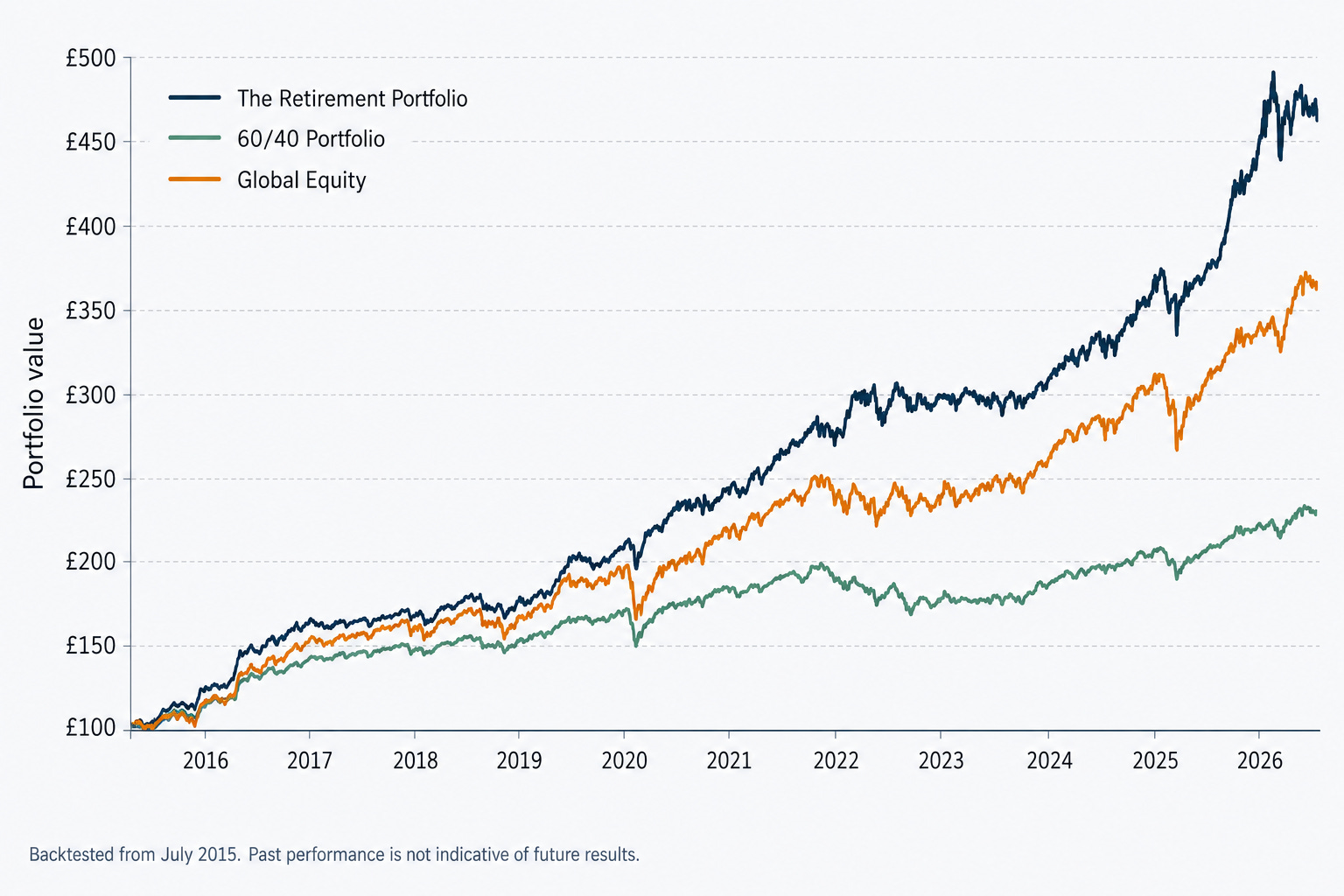
Good market rate returns of 15-16%, matching global indices like the S&P 500.
Low drawdowns - a maximum daily historical drawdown of -12.33% (that’s not in a single day, that is the biggest drawdown using daily data; other people may try sell you a system that uses monthly data, don’t fall for that!) The S&P went down -26% in the same period.
Best year +26.5%, worst +0.7% - yes, no negative years so far!
Very strong calmar ratio - this is the CAGR / max daily drawdown - a higher ratio is better, indicating greater returns for every unit of downside risk taken. It’s a phenomenal measure and tells you how a system actually feels to trade; so work it out yourself when you are comparing different systems out there.
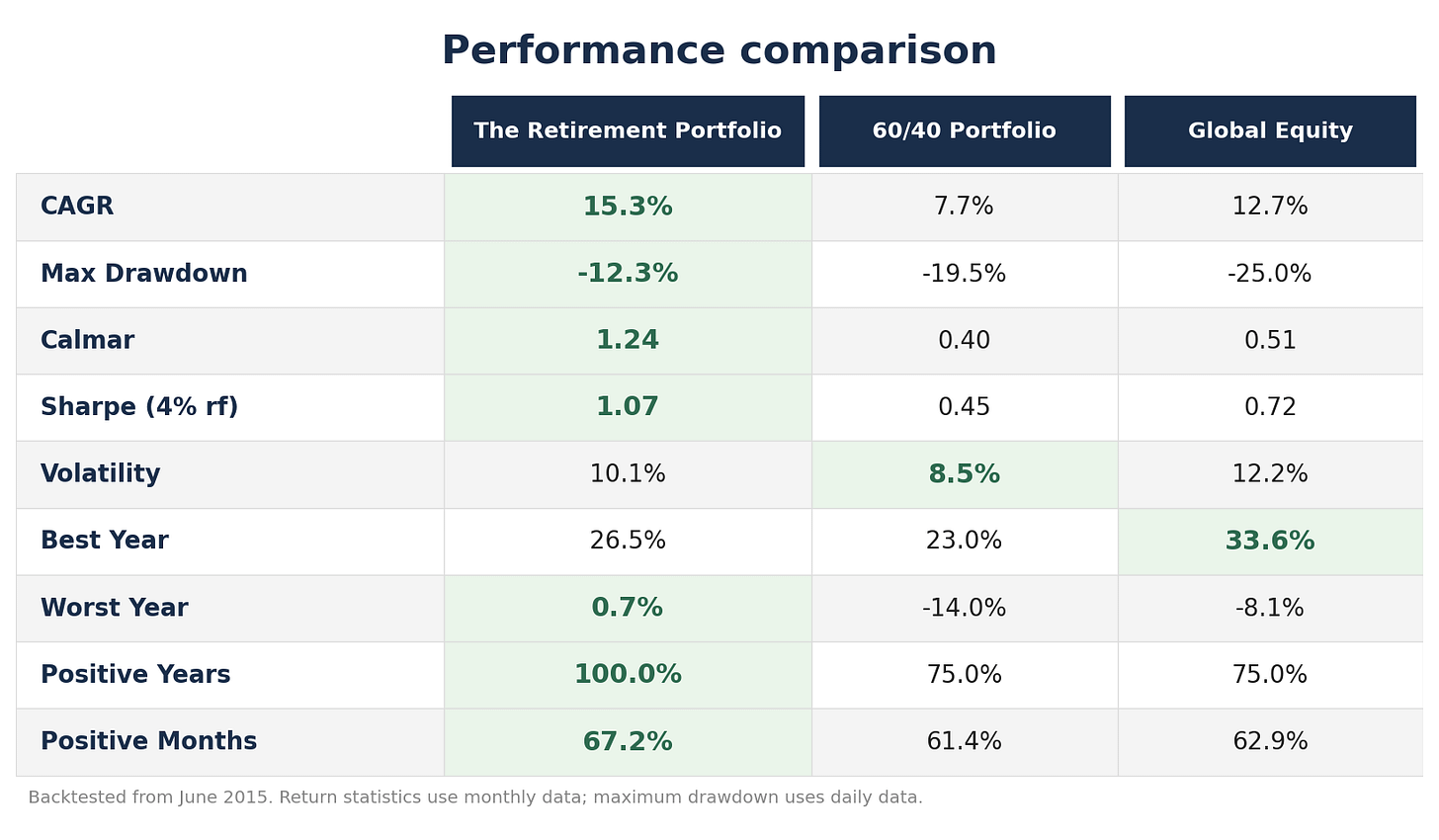
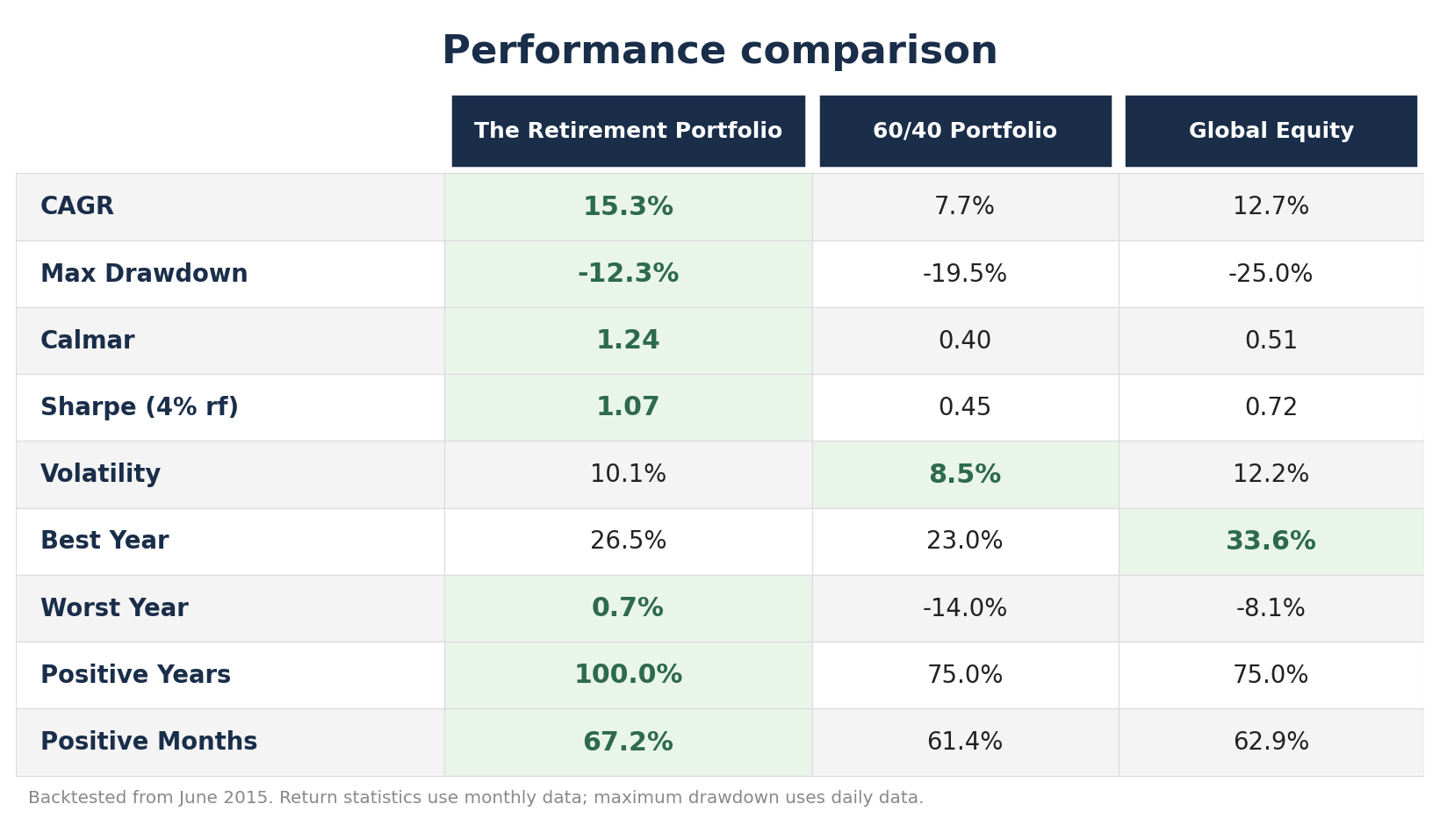
One important point: as mentioned above, the drawdowns shown here are calculated using daily portfolio values, not monthly observations.
Monthly drawdowns can significantly underestimate the true risk experienced by investors during fast-moving market declines. Whenever you compare investment strategies, make sure you understand how the maximum drawdown has been measured.
Why I Compare Against a Traditional 60/40 Portfolio
Many investment strategies compare themselves only against a global stock market index. While that may be appropriate for younger investors accumulating wealth, I don’t believe it reflects the reality faced by most retirees.
A retiree’s objective is different.
The goal is not simply to maximise returns. It is to generate long-term growth while avoiding the large portfolio declines that can permanently damage retirement income through sequence risk.
For that reason, I compare The Retirement Portfolio against two benchmarks:
A traditional 60/40 portfolio, representing a balanced retirement allocation.
A global equity portfolio, representing a conventional long-term growth investment.
This provides a fair comparison across different investing styles and helps demonstrate the trade-offs between return and risk.
Who This Is For
The Retirement Portfolio is designed primarily for investors who value capital preservation alongside long-term growth.
It may be particularly suitable for:
Retirees drawing an income from their investments.
Investors approaching retirement who wish to reduce portfolio risk.
Financially independent investors seeking a more resilient investment approach.
ETF investors who prefer systematic investing over stock picking.
Investors who appreciate a simple monthly process requiring only a small amount of time each month.
Investors who have realised that preserving wealth is often more important than chasing every last percentage point of return.
Who This Probably Isn’t For
This publication is unlikely to be suitable if your priority is maximising returns regardless of volatility.
It is probably not for:
Day traders.
Short-term market speculators.
Individual stock pickers.
Investors seeking high-risk, high-reward opportunities.
Anyone expecting guaranteed or uninterrupted outperformance.
Every investment strategy involves periods of disappointment.
My objective is not to eliminate those periods, but to reduce their severity while maintaining attractive long-term returns.
What Subscribers Receive
Subscribers receive a concise monthly update containing everything needed to follow the strategy.
This includes:
The current ETF allocation.
Any portfolio changes for the month ahead.
Commentary explaining the allocation.
Updated performance statistics and charts.
Ongoing research and improvements to the strategy where appropriate.
The strategy is deliberately straightforward.
If you have a standard brokerage account and can spare around fifteen minutes each month, you can implement the portfolio without needing to follow financial news or make discretionary investment decisions.
A Final Thought
After many years researching investment strategies, one lesson stands out above all others.
Successful investing is rarely about finding the highest possible return.
It is about building a portfolio you can remain committed to through every market cycle.
For retirees especially, avoiding unnecessary losses can be every bit as important as capturing gains.
That is the philosophy behind The Retirement Portfolio.
It is a systematic, evidence-based approach designed to help investors pursue long-term growth while placing capital preservation at the heart of the investment process.
If your priority is simply maximising returns, there are probably better newsletters to follow.
But if your goal is to build wealth while reducing the emotional and financial impact of large market declines, I believe you’ll find something valuable here.
I hope you’ll join me.
Subscribe below to receive the monthly portfolio updates and follow the strategy as it evolves.
Your strategy sounds ideal for somebody like me who has also recently retired early. The equity curve on your chart is remarkable not least for the fact that you have predicted all 3 of the last bear markets and got out of equities almost as soon as they have begun and then continued to make good profits through each of them. Can you tell me what it was about a quite normal January 2020 that made the system think that it was a good idea to go fully defensive? It does sound almost too good to be true that you have swerved all of these bear markets and made good profits at the same time. In 2022 there were not many places to make money apart from general commodities but your system got through that period very well.