
The Biggest Risk to Your Retirement Isn't Low Returns
It's the drawdown you don't recover from.

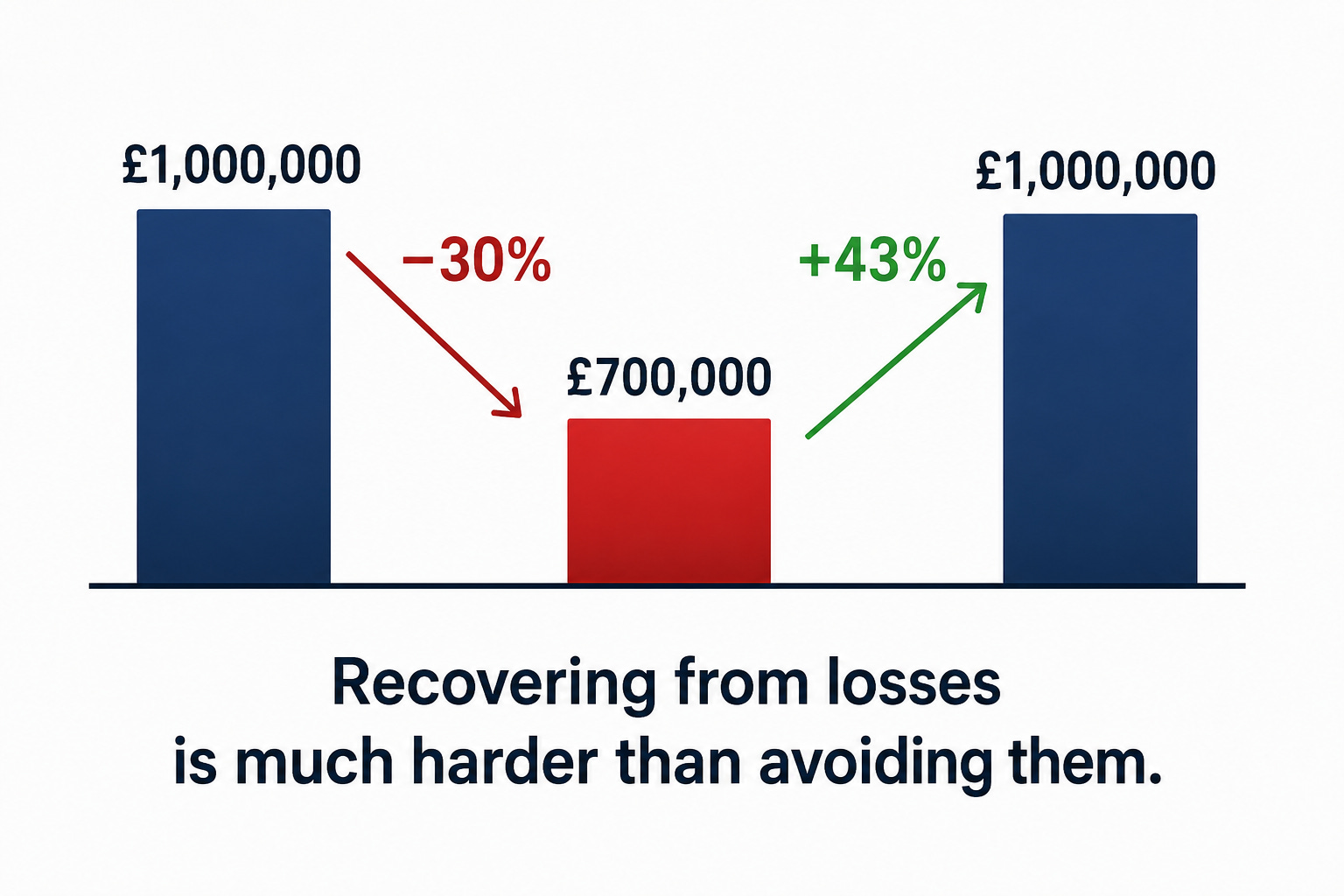
This article explains the philosophy behind The Retirement Portfolio and why I believe protecting capital matters more than chasing maximum returns.
Imagine you’ve spent forty years building a retirement portfolio worth £1 million.
You finally retire.
No more salary.
No more monthly contributions.
Your portfolio now has one job:
Fund the rest of your life.
Then the market falls 30%.
You don’t just lose £300,000 on paper.
You lose confidence.
You reduce spending.
You delay holidays.
You question your plan.
And if you’re withdrawing money at the same time, the damage can become permanent.
This publication exists because I believe most investors are solving the wrong problem.
Why I’m Writing This
Before explaining the strategy, I think it’s only fair to explain where it came from.
My background is in econometric modelling and data science, where I spent years analysing data, building models and making decisions based on evidence rather than opinion.
Investing became a natural extension of that mindset.
Like many investors, I began with a simple objective: build as much wealth as possible.
But as my own portfolio grew, and as I stepped away from full-time work, my thinking changed.
The question was no longer:
“How do I maximise returns?”
Instead it became:
“How do I protect what I’ve already built without giving up the opportunity for long-term growth?”
That question sent me down a rabbit hole of academic research into momentum investing, tactical asset allocation, portfolio construction, diversification, drawdowns and behavioural finance.
Over several years I built, tested and refined what eventually became The Retirement Portfolio.
Initially it was never intended to become a publication.
It was simply the framework I wanted to trust with my own money.
Over time I realised something.
There are thousands of websites teaching people how to become wealthy.
There are surprisingly few dedicated to helping people stay wealthy once they’ve achieved financial independence.
That’s why this publication exists.
The Problem
Spend five minutes reading investment news and you’ll quickly notice that almost every conversation revolves around one thing: returns.
Which fund returned the most last year?
Which ETF beat the S&P 500?
Which strategy delivered the highest CAGR over the last decade?
It’s understandable. Higher returns are exciting, easy to compare, and make for compelling headlines.
But if you’re retired—or planning to retire soon—I believe those are the wrong questions.
Retirement changes the rules.
When you’re building wealth, market declines can actually work in your favour. You’re still earning a salary, you’re regularly investing new money, and falling prices simply allow you to buy more shares at lower valuations.
Retirement is different.
Your salary has stopped.
Instead of adding money to your portfolio each month, you’re likely withdrawing from it to fund your lifestyle. That completely changes the mathematics of investing.
A large market decline early in retirement isn’t just uncomfortable—it can permanently reduce the sustainability of your portfolio. This is known as sequence-of-returns risk, and it is one of the most important yet least appreciated risks retirees face.
Two investors can achieve exactly the same average annual return over thirty years, yet experience dramatically different outcomes depending on when those returns occur. Suffering a major drawdown while simultaneously making withdrawals can leave a portfolio with far less capital available to participate in the eventual recovery.
Even if markets recover, your portfolio may never fully catch up.
Then there’s the human side of investing.
Most investors believe they can tolerate a 30% or 40% decline.
Very few actually can.
It’s one thing to see a drawdown on a backtest. It’s something entirely different when hundreds of thousands of pounds have disappeared from your own retirement savings, the financial news is predicting further declines, and you’re wondering whether your retirement plan is beginning to unravel.
This is where behaviour often becomes more important than mathematics.
Investors panic.
They sell.
They wait for “things to calm down.”
And, more often than not, they buy back after much of the recovery has already happened.
The result isn’t simply a temporary loss—it becomes a permanent reduction in long-term wealth.
That’s why I don’t believe the best retirement portfolio is necessarily the one with the highest historical return.
I believe it’s the portfolio that gives you the greatest chance of staying invested through difficult markets.
Because compounding only works if you’re still there to experience it.
A Different Way of Thinking About Retirement Investing
The Retirement Portfolio was built around a simple idea:
What if the objective isn’t to maximise returns, but to maximise the probability of reaching the end of retirement with both your wealth and your peace of mind intact?
That may sound like a subtle difference, but it changes almost every investment decision.
Rather than asking:
“Which portfolio produced the highest historical CAGR?”
I prefer to ask:
“Which portfolio gives me the highest probability of staying invested when markets become difficult?”
Those aren’t necessarily the same thing.
A strategy that produces exceptional long-term returns but regularly experiences 40–50% drawdowns may look wonderful on a spreadsheet.
Living through those declines with your own retirement savings is a completely different experience.
For many investors, the greatest investment risk isn’t choosing the wrong ETF.
It’s abandoning a perfectly sensible strategy at exactly the wrong moment.
That’s why The Retirement Portfolio places drawdown management at the centre of the investment process.
The goal isn’t to eliminate losses.
No strategy can do that.
The goal is to reduce them enough that investors are more likely to remain disciplined, stay invested and allow compounding to continue working over many years.
Evidence Before Opinions
I’m naturally sceptical of investment claims.
Every year another strategy promises market-beating returns with little risk.
Most disappear after a few years.
That’s why I believe investment strategies should be judged by transparent evidence rather than marketing claims.
Before deciding to publish this strategy, I wanted to understand how it behaved across very different market environments.
That meant analysing not only returns, but also drawdowns, volatility, consistency and risk-adjusted performance.
The charts below compare The Retirement Portfolio with two familiar alternatives:
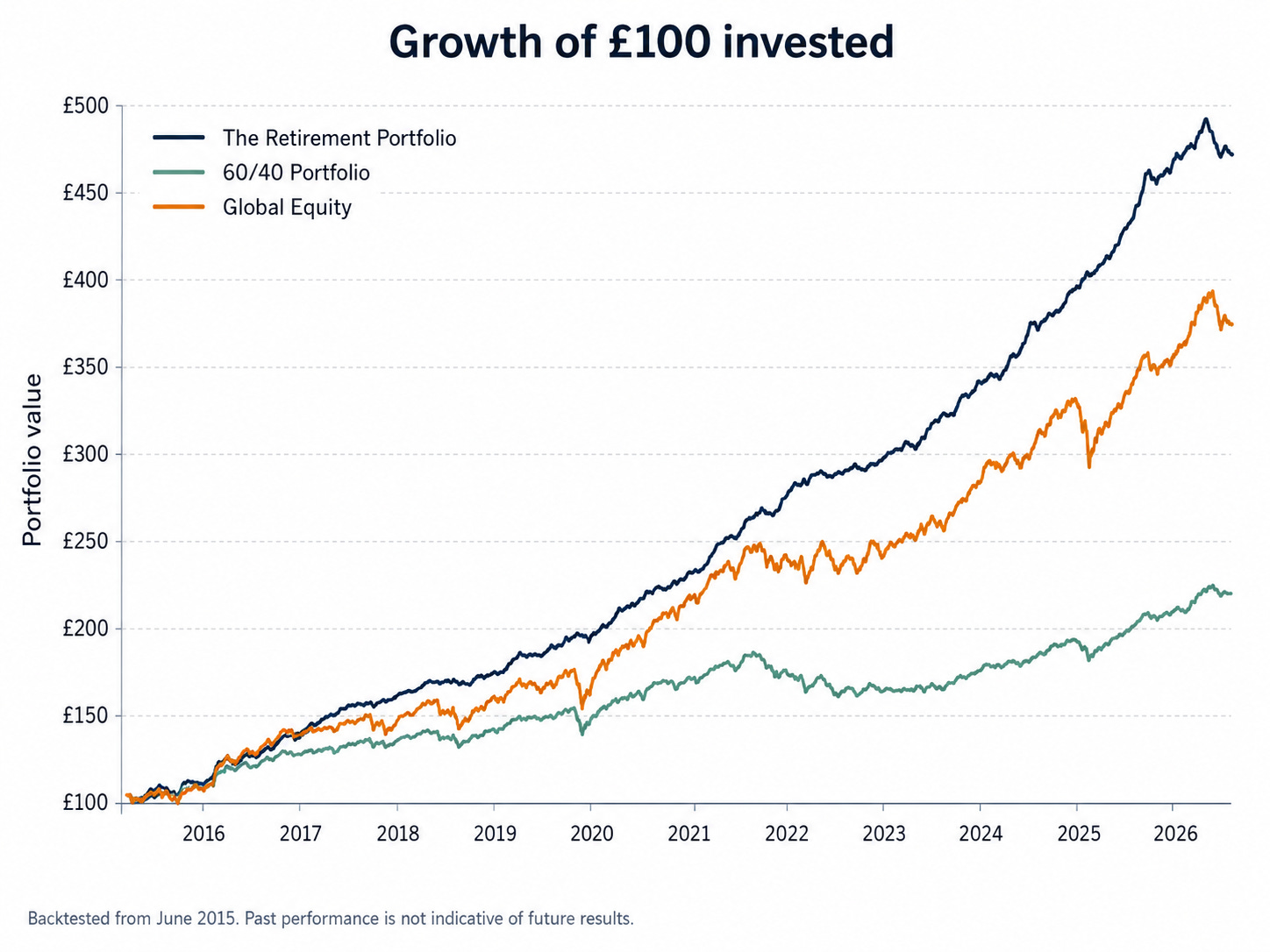
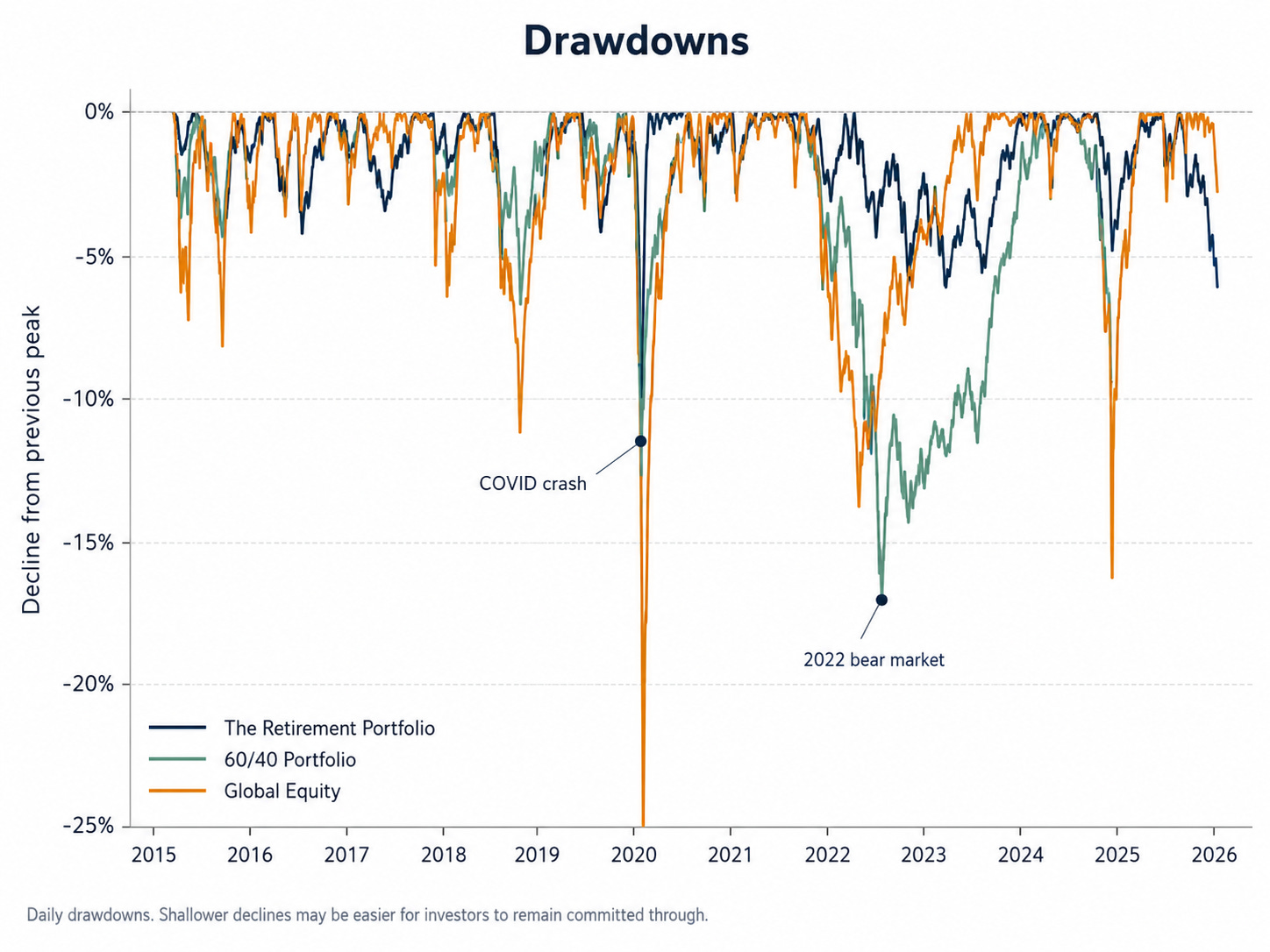
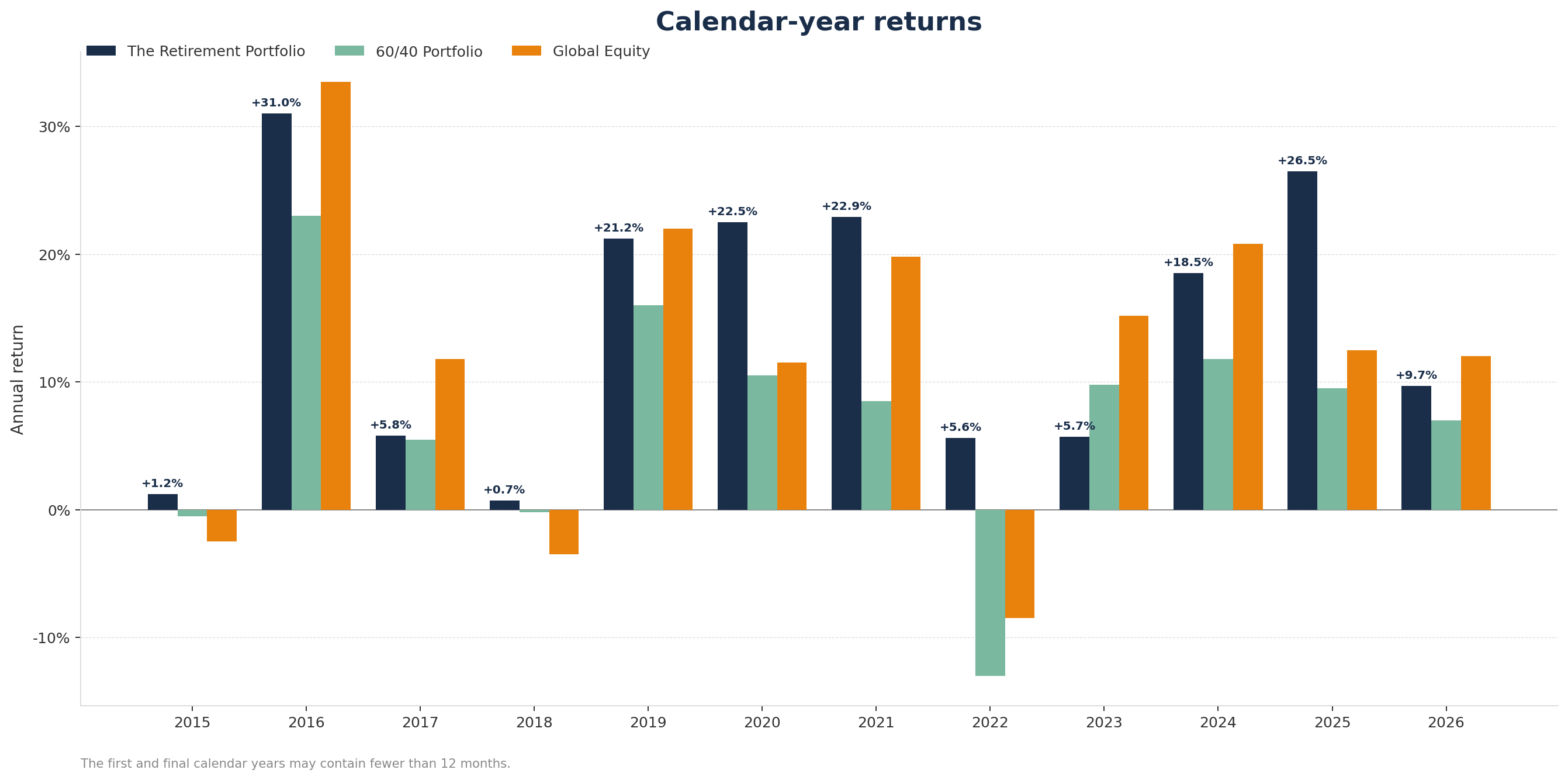
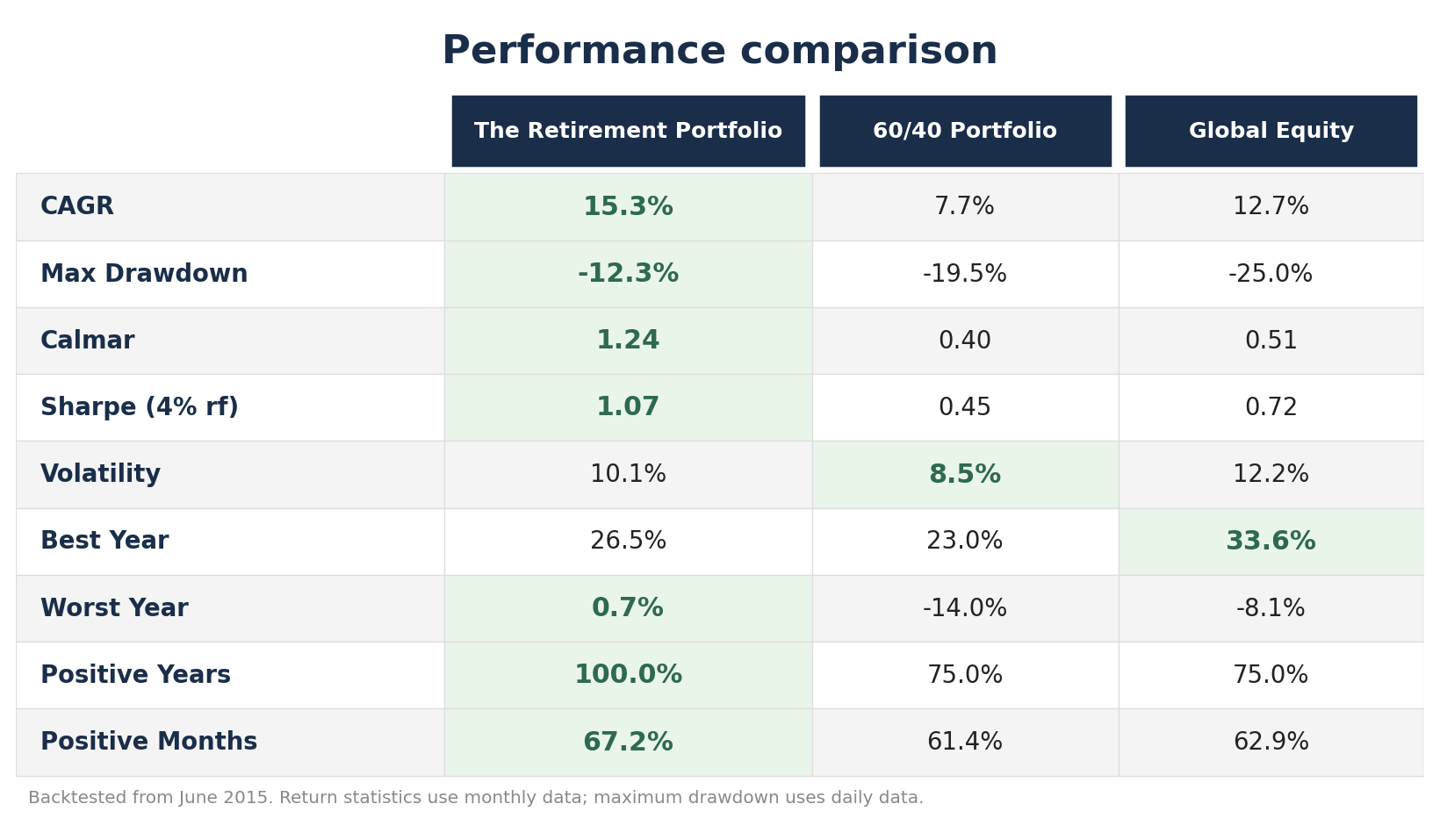
No backtest can predict the future.
Markets change.
Relationships between asset classes evolve.
Strategies experience periods of underperformance.
The purpose of historical testing isn’t to promise future returns.
It’s simply to understand how a strategy has historically behaved under very different economic conditions.
What You Should Expect
One of the biggest mistakes an investment manager can make is creating unrealistic expectations.
So let’s set some realistic ones from the beginning.
There will absolutely be periods when this strategy underperforms.
There will be years when a simple global equity ETF delivers higher returns.
There will be periods when defensive positioning causes the portfolio to lag rapidly rising markets.
That isn’t a flaw.
It’s an inevitable consequence of prioritising drawdown management alongside long-term growth.
If your only objective is to maximise returns regardless of volatility, there are likely to be more aggressive strategies available.
But if your objective is to achieve attractive long-term returns while reducing the emotional and financial burden of major drawdowns, I believe this approach deserves serious consideration.
No strategy wins every race.
The Retirement Portfolio isn’t trying to.
It is trying to help investors stay in the race.
Who This Publication Is For
This publication may be a good fit if you:
are retired, semi-retired or financially independent;
care more about preserving wealth than chasing the highest possible returns;
value evidence over forecasts;
prefer systematic investing to emotional decision-making;
want a process that requires only a few minutes each month.
It probably isn’t for you if you:
want to trade every day;
are searching for the highest possible return regardless of risk;
enjoy speculating on individual stocks or cryptocurrencies;
expect any investment strategy to outperform in every market.
That’s perfectly okay.
This publication isn’t trying to appeal to everyone.
It’s written for investors who understand that avoiding large losses can be just as important as achieving strong long-term returns.
Final Thoughts
Investing is often presented as a competition.
Who achieved the highest return?
Who beat the market?
Who found the next winning strategy?
I don’t see retirement investing that way.
I see it as a problem of endurance.
The investors who ultimately succeed are rarely those who discover the most exciting portfolio.
They’re the ones who discover an investment process they can continue following through both good markets and bad.
That’s the philosophy behind The Retirement Portfolio.
If that way of thinking resonates with you, I hope you’ll join me as we continue exploring what thoughtful, evidence-based retirement investing can look like.
Invest well. Stay invested.
Matthew
If this philosophy resonates with you, consider subscribing. Free subscribers receive educational articles on retirement investing, portfolio construction and drawdown management. Paid subscribers also receive the live monthly ETF allocation, portfolio updates and ongoing research.
I’ve been looking for an investing newsletter that’s focused more on protecting retirement savings than chasing the highest returns. This was a really interesting first read. Looking forward to seeing how the portfolio works and following the monthly updates.