
Mid-Year 2026 Performance Update
The portfolio is up approximately 9% so far this year

The Retirement Portfolio is up approximately 9% year to date as of mid-July 2026.
That is a solid result, particularly because the first half of the year has not been a smooth one.
The portfolio made strong gains during January and February, before giving some of those gains back during the spring. Markets became more unsettled, leadership shifted, and several previously strong assets weakened at the same time.
Despite that, the portfolio remains comfortably positive for the year.
2026 so far
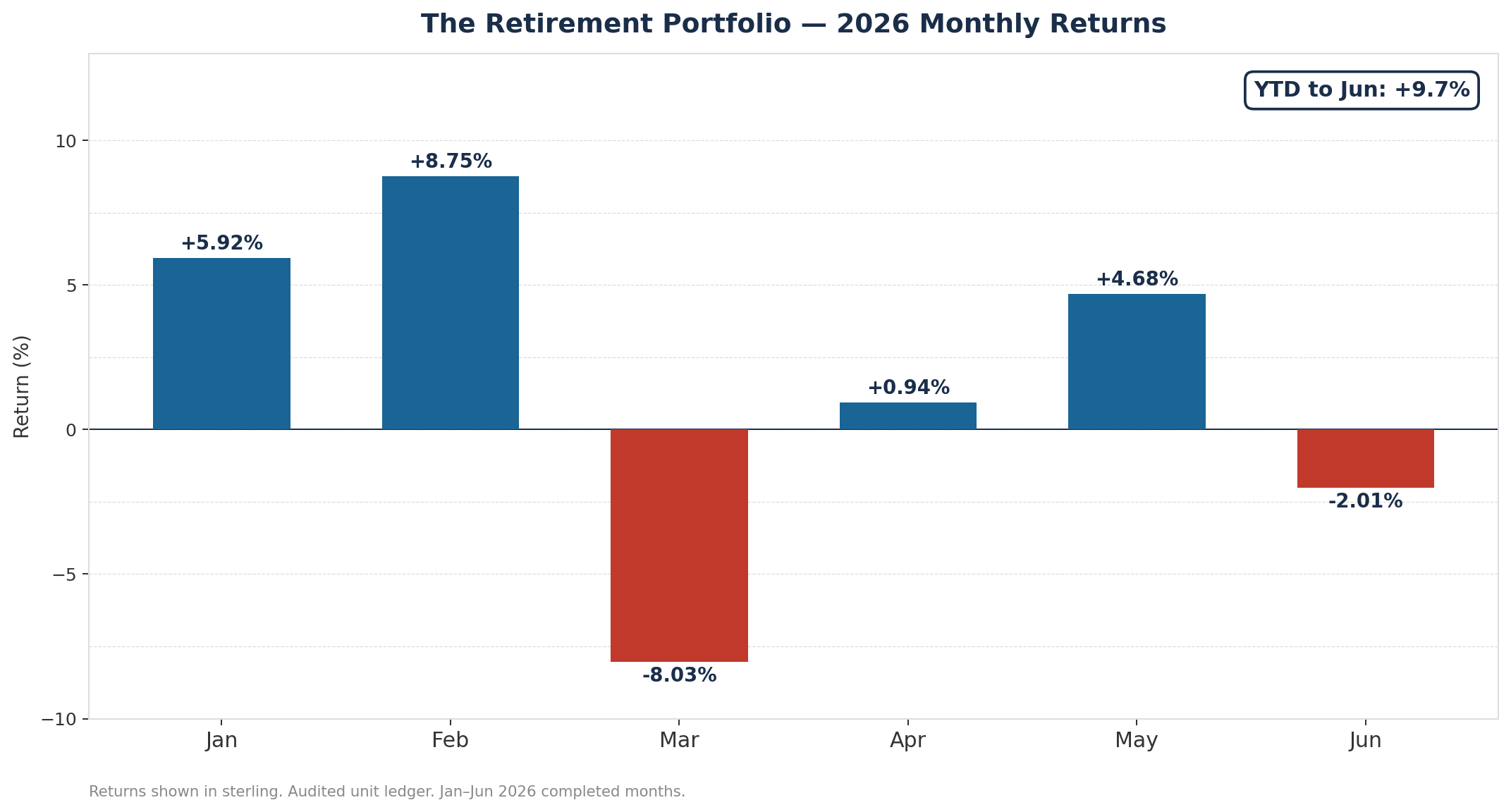
The year began strongly.
January and February produced the majority of the gains, while March and June were more difficult. The portfolio then stabilised as the balance between its growth and defensive holdings changed.
That pattern is worth highlighting because the portfolio has not simply risen in a straight line.
The year-to-date return has included:
strong positive months;
several meaningful setbacks;
changes in market leadership;
periods when growth and defensive assets moved against the portfolio at the same time.
The result has therefore been earned through a fairly demanding market environment rather than one uninterrupted rally.
What has driven performance?
The portfolio’s growth allocation benefited from continued strength in some of the largest equity markets and technology-related assets.
At the same time, the defensive side of the portfolio has had a more mixed year.
Gold performed very strongly earlier in the period but later weakened sharply. Government bonds and index-linked bonds also struggled to provide consistent protection.
Broad commodities have been one of the stronger defensive areas more recently.
This is precisely why the portfolio does not rely on a single permanent defensive asset. Different assets respond to different economic conditions, and the strongest defensive market can change over time.
The drawdown has still been uncomfortable
Although the portfolio remains positive for the year, it has experienced a noticeable drawdown from its February peak.
That is an important reminder that a positive year-to-date return does not mean the journey has been easy.
An investor looking only at the starting value and the current value would miss much of what happened in between.
The portfolio rose strongly, declined, partially recovered and then experienced further weakness.
That kind of path is normal. The aim of the strategy is not to eliminate every setback, but to prevent a manageable decline from developing into something much more damaging.
How the result compares
A return of approximately 9% in just over half a year is ahead of the portfolio’s long-term target.
It should not be treated as a normal expected six-month return, and it should certainly not be projected forward.
Some periods will be much weaker. There will also be years when the portfolio trails a fully invested equity portfolio.
The relevant point is that the portfolio has continued to make progress while operating within a significantly more controlled risk framework than an all-equity approach.
What I am watching next
The second half of the year begins with a very different market mix from the one seen in January.
Equity leadership remains relatively concentrated, bond markets remain uncertain, and defensive assets are no longer moving together.
The portfolio will continue to respond monthly rather than trying to forecast what happens next.
The main things I will be watching are:
whether equity strength broadens or narrows further;
whether commodities retain their momentum;
whether gold stabilises after its recent weakness;
whether bonds begin to offer meaningful defensive strength again;
whether the current drawdown starts to recover.
None of these require a discretionary prediction. They simply determine which assets continue to rank most strongly within the system.
Final thought
The portfolio is up approximately 9% so far in 2026, but the more useful lesson is how unevenly that return has arrived.
There have already been strong gains, reversals and periods of uncomfortable weakness.
That is exactly why a rules-based process matters.
The objective is not to produce a perfect line upwards. It is to keep making progress while controlling the damage when conditions change.
So far, 2026 has been a good test of that principle. For monthly trade signals, join by clicking below.
Past performance does not guarantee future results. Figures are based on a backtested model and are provided for information only.